Search This Blog

Tuesday, 24 January 2012

A great conspiracy theory

Consider this plot for a great suspense novel.

A well-known author is afraid of becoming non-relevant, and yesterday's creator of best-sellers. So he hits upon the age old remedy - become controversial for the heck of it.

His publishers baulk at the book he's written - in the opinion of some of the more perverse and vocal members of the reading public, not only are his books unreadable, some even consider them unwritable.

So, the author hatches a plot. His marketing agent, the genius at his PR agency, and the author figure out that they must get the book banned. Like in the olden days, American authors used to strive to get their books banned in Boston, to ensure it sold millions elsewhere.

Of course, the catch is that nowadays nobody bans a book for bad language, prurience, obscenity or even just plain awful writing - the reading public have to take their chances with such perils. So, they hit upon the ultimate sales weapon - the book must be banned for hurting the religious sentiments of a large part of the population of a large country which is a so-called democracy, but is really a appease-ocracy to various vote banks.

The rest is history...the book becomes and remains a best-seller although very few people ever read it; every time the author or the book gets mentioned in public, a few individuals start foaming at the mouth, and the others rush to placate them; a few individuals who wish to represent the sensible majority of readers feel aggrieved at the suppression of the freedom of speech; the vast majority of the population who had never heard of the author or the book google diligently for free pdfs or ebooks.

I think I will write this plot up as a thriller movie script, where a ninja team is out to get the author, and Jet Li and Rajinikanth team up to foil their nefarious plans. All I need to thereafter is to get it banned somewhere.

Thursday, 19 January 2012

A detour to the Zambezi

Shankar and Diego don't actually track the Zambezi for long. But the Zambezi is such a wonderful place that I have decided to share some information about the river anyway. So here goes. (Incidentally, you can go here and here for more details about the river. The first one is a beautiful site on tourism in Zambia, and has some great pictures of the Zambezi.)

The Zambezi (also spelled Zambesi) is the fourth-longest river in Africa, and the largest flowing into the Indian Ocean from Africa. The area of its basin is 1,390,000 square kilometres (540,000 sq mi),[1][2] slightly less than half that of the Nile. The 3,540-kilometre-long river (2,200 mi) has its source in Zambia and flows through Angola, along the borders of Namibia, Botswana, Zambia again, and Zimbabwe, to Mozambique, where it empties into the Indian Ocean.

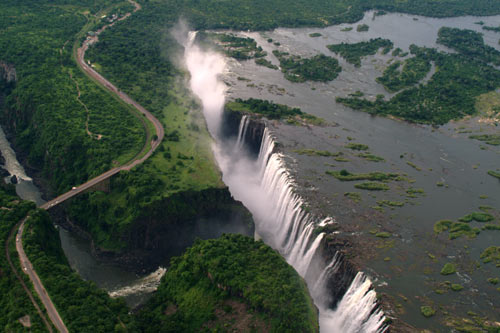
The Zambezi's most spectacular feature is the beautiful Victoria Falls. Other notable falls include the Chavuma Falls at the border between Zambia and Angola, and Ngonye Falls, near Sioma in Western Zambia.

The size of the river basin is pretty huge:

Easily the most spectacular sight in the river, and indeed the world, is the Victoria Falls. Some day, some time, you must see it for yourself. These photos can at best be an appetizer.


Diamonds and Death

[My book "Mountain of the Moon" is available at various online stores such as RupaFlipkartInfibeamBookadda,CrosswordLinuxbazar (!!), and at Rediff.] 


The epic journey undertaken by Shankar and Diego Alvarez had just one goal - find the diamonds hidden in the Mountain of the Moon. This dream, or maybe it's just greed, has driven men for millenia. The search for riches has not only created huge people migrations in the 18th and 19th centuries, they have also created great works of art and entertainment - Chaplin's "The Gold Rush", the Indiana Jones films, the books by Rider Haggard, and of course "Chander Pahar."


The search for riches often results in failure and death, and not very pleasant deaths either. In "Chander Pahar", both Jim and Diego are torn apart by the three-toed monster which Shankar never gets to see. In finding the diamonds in the Richtersveldt Mountains, Shankar loses his way in the tunnels and almost dies of thirst.


This relationship between diamonds and death is still not dead (no pun intended!) Many of us will have seen the film "Blood Diamond", the 2006 political thriller film directed by Edward Zwick and starring Leonardo DiCaprio, Jennifer Connelly and Djimon Hounsou. The title refers to blood diamonds, which are diamonds mined in African war zones and sold to finance conflicts, and thereby profit warlords and diamond companies across the world. Wikipedia has this to say about 'blood diamonds', aka 'conflict diamonds' - "In relation to diamond trading, conflict diamond (also called a converted diamond, blood diamond, hot diamond, or war diamond) refers to a diamond mined in a war zone and sold to finance an insurgency, invading army's war efforts, or a warlord's activity, usually in Africa where around two-thirds of the world's diamonds are extracted. The phenomenon of conflict minerals has the same nature."


The countries in Africa that are affected by these stones include Angola, Liberia, Sierra Leone, Côte d'Ivoire, Democratic Republic of the Congo, The Republic of Congo and Zimbabwe. The UN has a fascinating article on Conflict Diamonds here.


Probably the most famous diamond mines in the world are the Kimberley mines, in Northern Cape in South Africa. The town has considerable historical significance due its diamond mining past and siege during the Second Boer War. Notable personalities such as Cecil Rhodes (the founder of Rhodesia, now Zimbabwe) made their fortune here and the roots of the De Beers corporation can also be traced to the early days of the mining town. There's a fascinating history of the mines here,here, and here.


The original Kimberley mine closed in 1914, a few years before Shankar's visit to Africa.

Which is the REAL Mountain of the Moon?

While reading and translating "Chander Pahar", I was very curious about the realMountains of the Moon - was there such a place at all?

It turns out that there is indeed such a place. The term Mountains of the Moon orMontes Lunae referred to a mountain range in central Africa that is the source of the White Nile - check this out. However, the real Mountains of the Moon is far away from the final setting of Shankar's adventure; the source of the White Nile is Lake Victoria in Tanzania.

The location of these fabled mountains had been disputed over the centuries. The Scottish explorer, James Bruce identified the Mountains of the Moon with Mount Amedamit in Ethiopia.

G.W.B. Huntingford suggested in 1940 that the Mountain of the Moon should be identified with Mount Kilimanjaro (left - one of the most beautiful mountains in the world), and "was subsequently ridiculed in J. Oliver Thompson's History of Ancient Geography published in 1948". Huntingford later noted that he was not alone in this theory, citing Sir Harry Johnston in 1911 and Dr. Gervase Mathew later in 1963 having made the same identification.


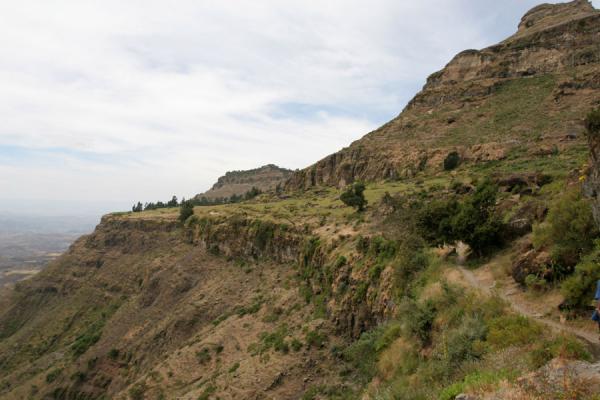
O. G. S. Crawford identified this range with the Mount Abuna Yosef area in the Amhara Region of Ethiopia. The picture on the left is of the path leading to Mekina Medhane Alem church (Lalibela).

"Mountains of the Moon" is also the name of a movie - see here - which tells the story of Captain Richard Francis Burton's and Lt. John Hanning Speke's expedition to find the source of the Nile river in the name of Queen Victoria's British Empire, their meeting, their friendship emerging amidst hardship, and then dissolving after their journey. I haven't seen the movie; this review from Rotten Tomatoes is quite interesting. "Director Bob Rafelson fulfilled a lifelong dream when he finally received backing to complete Mountains of the Moon. The film recreates the exploratory adventures of 19th century visionaries Sir Richard Burton (Patrick Bergin) and John Henning Speke (Iain Glen). The heart of the film is the effort by Burton and Speke to discover the true source of the Nile river. This occurs well into the film, after several torturous scenes involving the injuries sustained by the protagonists during other expeditions and their growing friendship (which, the film intimates, goes far beyond friendship). Rafaelson's fascination with this story, and his insistence upon painstaking historical accuracy, unfortunately compromises his ability to make an interesting film. There are so many starts and stops during the first half that we sincerely hope Burton and Speke will chuck it all and set up a pub in Bristol or something. What saves Mountains of the Moon is the rapport between its stars and the brilliant, epic-like cinematography of Roger Deakins."

Mountains in Chander Pahar - 2

The two major mountain ranges I will write about here are the Ruwenzori and the Richtersveldt - the latter is, of course, the more important as the location where Shankar's denouement with destiny gets played out.

The picture on the left is pretty amazing - it could be from the Alps or the Himalayas!

"The Rwenzori Mountains, previously called the Ruwenzori Range (the spelling having been changed in about 1980 to conform more closely with the local name), and sometimes the Mountains of the Moon, is a mountain range of central Africa, often referred to as Mt. Rwenzori, located on the border between Uganda and the Democratic Republic of the Congo, with heights of up to 5,109 m (16,761 ft). The highest Rwenzoris are permanently snow-capped, and they, along with Kilimanjaro and Mount Kenya are the only such in Africa." For more, visit this, and this; the latter is particularly beautiful. 

The Richtersveldt is also a national park in South Africa, and is far from the forbidding and forboding mountain range where explorers died a horrible death. This could look like the place where Shankar was rescued - except that he was found in Rhodesia, and the Richtersveldt is in South Africa!


As this article mentions, it is "A favourite amongst nature travellers to South Africa, the landscape is sometimes described as "martian". Though barren and desolate at first glance, closer examination reveals the area to be rich in desert lifeforms, with an array or unique species specially adapted for survival." Wikipedia has a great article here, and if you love traveling, you must visit this as well.

Mountains in Chander Pahar - 1

One of the most exciting episodes in the book is the eruption of the volcano and the miraculous escape from certain death of Diego Alvarez and Shankar.

The African continent is highly seismically active, and indeed "Africa is the only region other than the Mediterranean with an historically dated B.C. eruption (at Mount Cameroon, observed by a passing Carthaginian navigator in the 5th century B.C.)." For more details, you should check this and this.

In this post, we shall visit only the mountains that the author has mentioned.

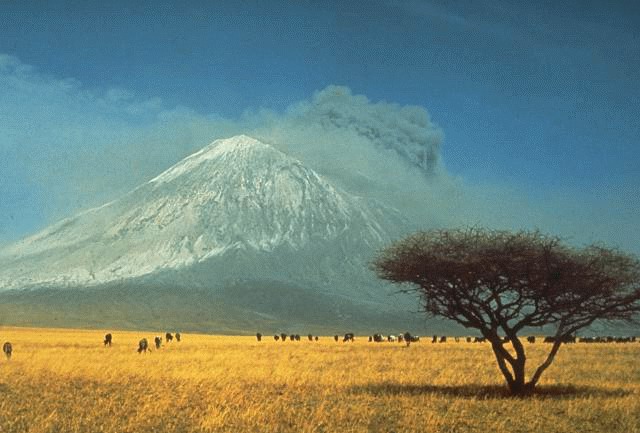
First, the mountain called Ol Doinyo Lengai.

This is an active volcano located in the north of Tanzania and is part of the volcanic system of the Great Rift Valley in Eastern Africa. It is located in the eastern Rift Valley, south of both Lake Natron and Kenya. It is unique among active volcanoes in that it produces natrocarbonatite lava, a unique occurrence of volcanic carbonatite. Further, the temperature of its lava as it emerges is only around 510 °C (950 °F). A few older extinct carbonatite volcanoes are located nearby, including Homa Mountain (ref. Wikipedia).

Another volcano the author mentions is Chimanimani. The Mountains, with their jagged peaks and deep ravines, form a natural border with Mozambique for 40km. Whilst most of the range is in Mozambique, much of the Zimbabwean side is now protected within the Chimanimani National Park.

"The Chimanimani Mountain range is a geological feature pertaining to that rent that runs from the Cape to the Levantine, and is known along most of its distance as the Great Rift Valley. It marks the collision of two tectonic plates, and is poised at the apex of several local ecological zones. The featured of the range are clearly old. There is a gnarled, Tolkienesque venerability in the many, many cracks and fissures, gorges and gullies, lakes and rivers." To read more about this picturesque place, please go here.
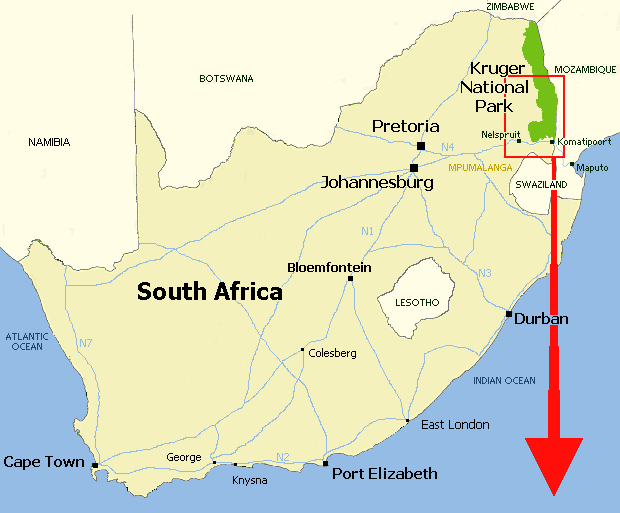
The author mentions Kruger Mountains.

The closest I could get to that is the Kruger National Park, one of the largest game reserves in Africa. To find out more, go here.

The Virunga Mountains, also mentioned in the book, are a chain of volcanoes in East Africa, along the northern border of Rwanda, the Democratic Republic of the Congo (DRC) and Uganda.

Volcano tourism is big there, and here's an article on this: "Virunga invites tourists to see Mount Nyamulagira volcano erupt!" Requires more gumption and colones than I, for one, possess!!
There are a few other mountains that the author mentions - Ruwenzori and Richtersveldt being the most important - I will write about them in another post.

More intrepid adventurers in Mountain of the Moon

[The book is available at various online stores such as Rupa, Flipkart, Infibeam, Bookadda, Crossword, Linuxbazar (!!), and at Rediff.com]

There are three other explorers that Bibhutibhushan mentions in Chander Pahar - Fernando Po, Filippo de Filippi, and the Duke of Abruzzi.

Fernando Po (Wikipedia gives him many spellings - Fernão do Pó, Fernão Pó, Fernando Pó, as well as Fernando Poo!) was a Portuguese navigator and explorer of the West African coast. He discovered the islands in the Gulf of Guinea around 1472, one of which until the mid 1900s bore a version of his name, Fernando Pó or Fernando Poo. The island is presently named Bioko, part of Equatorial Guinea. His name had also been given to several other places in nearby Cameroon; the village of Fernando Pó, Portugal; the village of Fernando Pó, Sierra Leone; and is the original name of the islands of São Tomé and Príncipe, which bore his name until the 20th century.

Filippo de Filippi was a real explorer and a famous mountaineer as well. He (April 20, 1814 – February 9, 1867) was an Italian doctor, traveler and zoologist. According to Wikipedia, Filippo De Filippi was born in Pavia. He succeeded Giuseppe Gené as professor of zoology and comparative anatomy at the University of Turin. He was the director of the scientific group affiliated with the first official mission sent to Persia in 1862, intended to re-establish diplomatic relations between the two countries.

Later made a Senator of the Kingdom of Italy, De Filippi set out in 1866 on a government-sponsored scientific voyage to circumnavigate the globe. The ship, the Italian warship Magenta, sailed under the command of Vittorio Arminjon, departing Montevideo on February 2, 1866. It reached Naples on March 28, 1868. However, De Filippi himself died en route at Hong Kong, on February 9, 1867, from serious dysentery and liver problems. He was 53 years old.

An interesting entry in The 1911 Classic Encyclopedia reads "... In 1909 de Filippi went with the Duke [of Abruzzi]'s expedition to the western Himalaya and Karakoram mountains, when a peak 24,600 ft. in height, close to Mount Godwin-Austen, or K2, was ascended. He later (1913-4) organized and led an important scientific expedition to the Karakoram mountains and central Asia, under the auspices of the Indian and Italian Governments, and for his valuable investigations received in 1916 an hon. K.C.I.E. from the Indian Government. He has also received many honours from British and foreign scientific societies, and is a gold medallist of the English and Italian Royal Geographical Societies. During the World War he served in the Italian army medical service, and also lectured in England on subjects connected with the war."

Prince Luigi Amedeo Giuseppe Maria Ferdinando Francesco di Savoia-Aosta, Duke of the Abruzzi, was one of the finest explorers and mountaineers in the first half of the 20th century. His Wikipedia entry is quite extensive, and this link to a virtual museum is really wonderful. His name has been immortalized by the "the Abruzzi Ridge or Spur" on K2. Check this out.